Mineral Enrichment of Iron Ore and Other Raw Materials for a Steel Plant
Introduction
Mineral enrichment, also called beneficiation, is the process of improving the quality of mineral raw materials by removing unwanted gangue and impurities and increasing the concentration of valuable minerals. In an integrated steel plant, beneficiation is particularly important for iron ore, but similar enrichment and preparation techniques are also applied to other raw materials such as coal, limestone, and dolomite.
The main objectives are to:
Increase the concentration of useful minerals.
Reduce gangue and undesirable impurities.
Improve the physical and chemical properties of the raw material.
Produce a consistent feed for sintering, pelletizing, coke making, or ironmaking.
Improve furnace productivity and reduce fuel and flux consumption.
Iron Ore Beneficiation
Iron ore may contain valuable iron-bearing minerals such as hematite (Fe₂O₃), magnetite (Fe₃O₄), goethite, and limonite, along with gangue minerals such as silica, alumina, and clay.
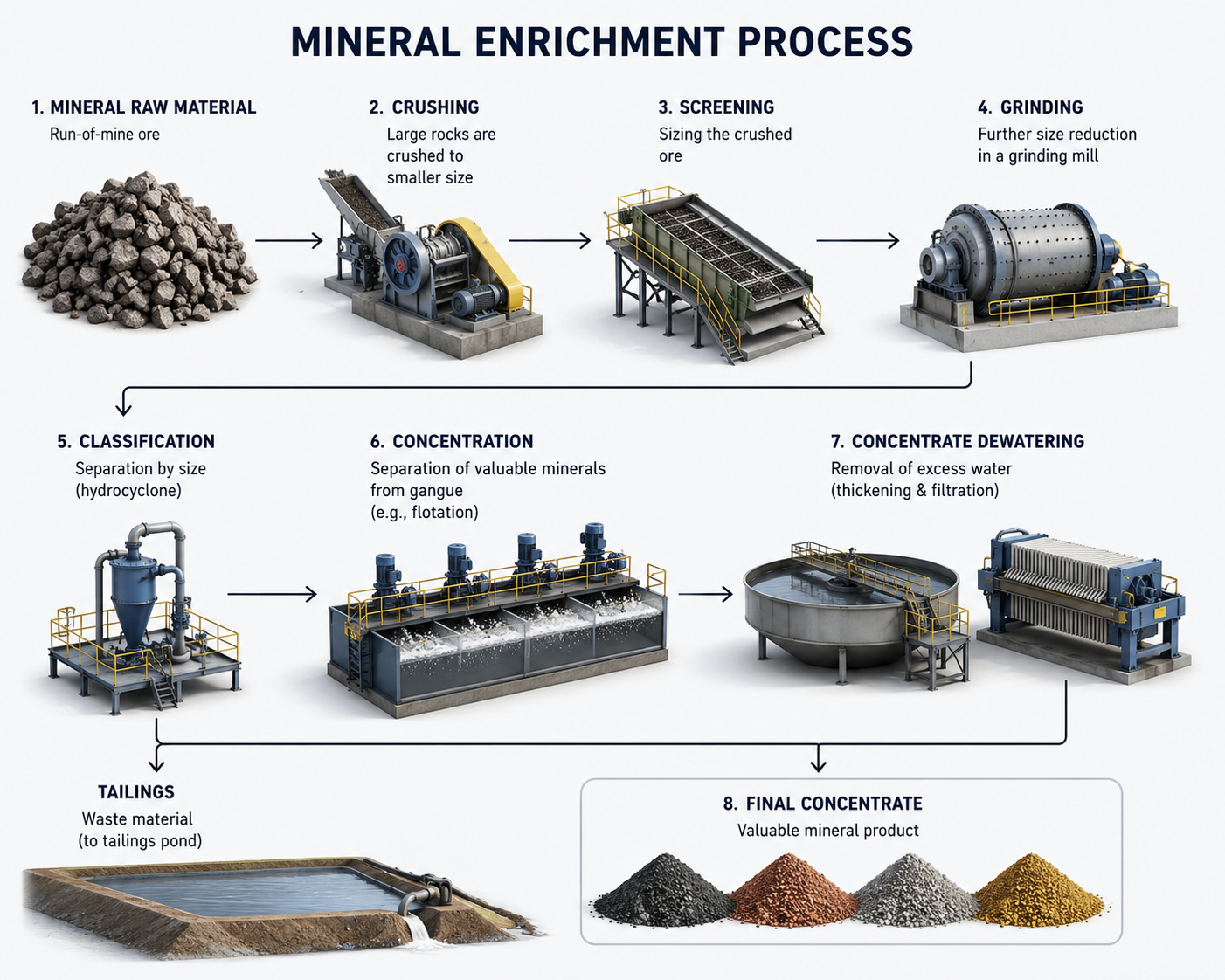
The major stages of iron ore beneficiation are:
a) Crushing and Screening
Run-of-mine ore is crushed to reduce its size and screened into different size fractions. Oversize material is returned for further crushing.
b) Grinding
Fine grinding is used when the iron-bearing minerals are finely interlocked with gangue. Grinding liberates the valuable iron minerals from the unwanted minerals.
c) Washing and Scrubbing
Water-based washing or scrubbing removes clay, adhering fines, and other contaminants. This can improve the iron grade and reduce alumina and silica in suitable ores.
d) Magnetic Separation
Magnetic separation is mainly used for magnetite and other magnetic iron-bearing minerals. Stronger magnetic separators can also recover some weakly magnetic minerals after suitable processing.
e) Gravity Separation
Gravity methods such as jigs, spirals, and shaking tables separate minerals according to differences in density. They may be used for suitable hematite and other iron ores.
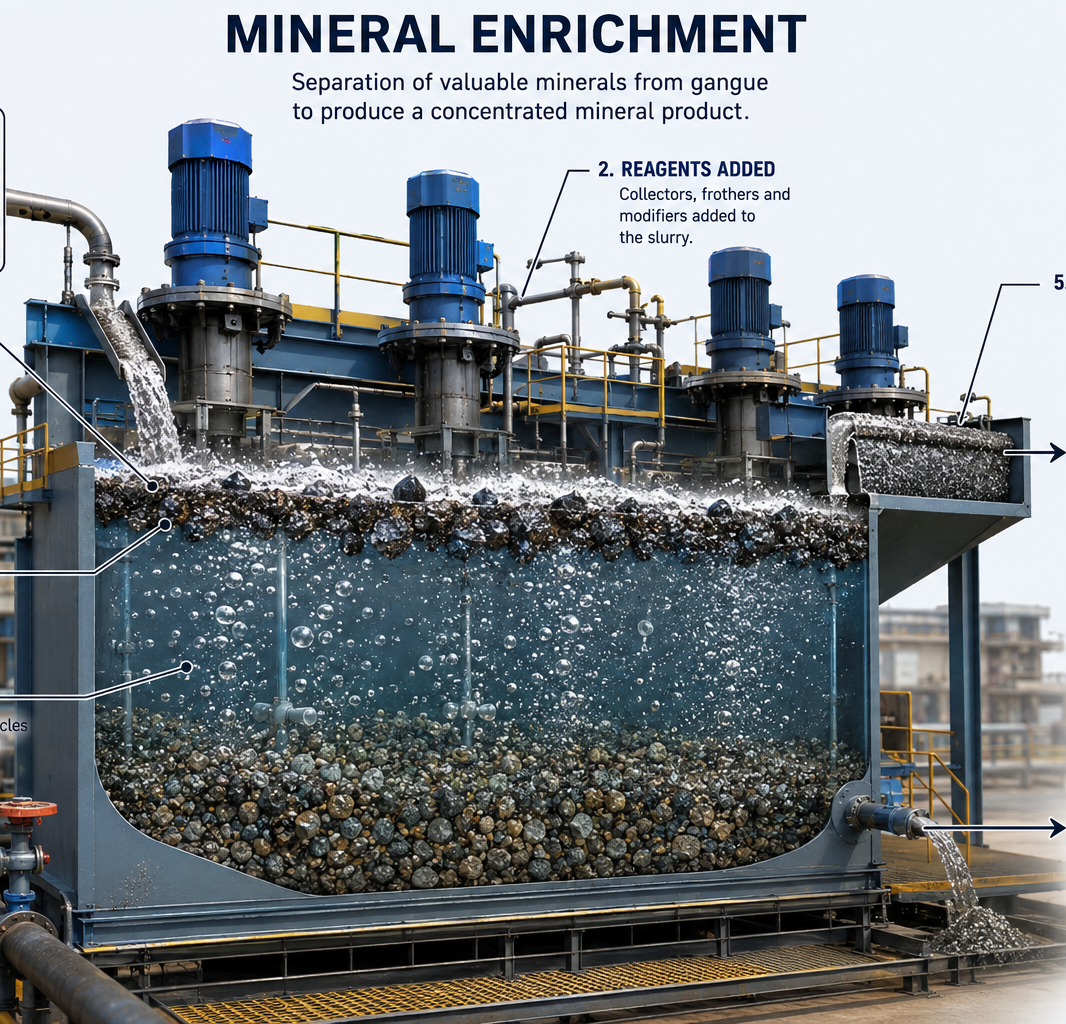
f) Flotation
Flotation is used to separate finely liberated iron minerals from silica and other gangue. It is particularly useful when conventional physical separation is insufficient.
g) Thickening and Filtration
After wet beneficiation, the slurry is thickened and filtered to recover water and produce a suitable filter cake.
h) Pelletizing or Sintering
Very fine beneficiated iron ore concentrate cannot normally be charged directly into a blast furnace. It is therefore converted into pellets or used as a component of sinter feed.
Important Quality Parameters for Iron Ore
The important parameters considered during beneficiation include:
Fe content: Higher Fe generally means higher iron yield and better furnace performance.
SiO₂: Excess silica increases slag volume and flux requirements.
Al₂O₃: High alumina can adversely affect slag properties and blast-furnace operation.
P and S: These are undesirable impurities because they can affect steel quality.
Moisture: Influences handling, transport, and process efficiency.
Particle size distribution: Important for sintering, pelletizing, and furnace permeability.
LOI (Loss on Ignition): Relevant particularly for hydrated iron ores and some concentrates.
Coal Preparation
Coal is an important raw material for producing coke in an integrated steel plant. Coal beneficiation reduces ash and unwanted mineral matter and improves the quality of the coal blend.
Typical operations include:
Crushing and sizing.
Screening.
Dense-medium separation.
Jigs or other gravity separation methods.
Fine-coal treatment and dewatering.
Beneficiated coking coal generally provides a more suitable feed for coke ovens by reducing ash and improving consistency.
Limestone and Dolomite
Limestone and dolomite are primarily used as fluxes in ironmaking and steelmaking.
Their preparation generally involves:
Crushing.
Screening and sizing.
Removal of unwanted fines or contaminants where necessary.
Proper storage and blending to maintain consistent chemical composition.
Limestone mainly supplies CaO, while dolomite supplies CaO and MgO. These oxides help form and control the slag during metallurgical operations.
Manganese Ore and Other Alloy-Bearing Materials
Manganese-bearing materials may be upgraded through crushing, screening, gravity separation, magnetic separation, or other suitable methods depending on the ore characteristics.
Manganese is important in steelmaking because it contributes to strength and helps control the effects of sulfur. Other mineral raw materials containing alloying elements may also require sizing, concentration, or blending before use.
Benefits of Mineral Enrichment
Effective beneficiation and raw-material preparation provide several advantages:
Higher metal recovery and grade.
Lower gangue and impurity levels.
Reduced slag generation.
Lower flux and fuel consumption.
Improved blast-furnace productivity.
Better sinter and pellet quality.
More stable and predictable plant operation.
Improved utilization of lower-grade ores.
Reduced transportation of unwanted gangue.
Better overall economic and environmental performance.
Conclusion
Mineral enrichment is an essential part of the raw-material preparation system of a modern steel plant. For iron ore, processes such as crushing, screening, washing, grinding, magnetic separation, gravity separation, flotation, and pelletizing/sintering are selected according to the mineralogy and liberation characteristics of the ore. Similar preparation and beneficiation techniques are applied to coal and other raw materials.
The ultimate objective is to supply the steel plant with high-quality, consistent, and suitably sized raw materials, thereby improving productivity, reducing operating costs, and maintaining the required quality of hot metal and steel.