Finishing Mills:
Delivering End-to-End Solutions for Steel Finishing
The final stages of steel manufacturing are critical to delivering products that meet customer specifications for quality, dimensional accuracy, surface finish, and timely delivery. Efficient finishing operations, coupled with well-designed storage and dispatch systems, ensure that finished products move seamlessly from production to customers while maintaining product integrity and operational efficiency.
Finishing mills play a vital role in achieving the final dimensions, mechanical properties, and surface quality required for a wide range of steel products. Our professionals have hands-on experience supporting finishing operations for long and flat product mills.
This includes:
- Bar and Wire Rod Finishing Mills
- Section and Structural Mills
- Rail and Heavy Section Mills
- Hot Strip Finishing Mills
- Plate Finishing Lines
- Cold Rolling and Finishing Support
- Cooling Beds and Controlled Cooling Systems
- Shearing, Cropping and Cutting Equipment
- Coiling, Bundling and Strapping Systems
- Surface Inspection and Quality Assurance Systems
- Mechanical, Electrical & Instrumentation Maintenance
- Process Optimisation and Productivity Improvement
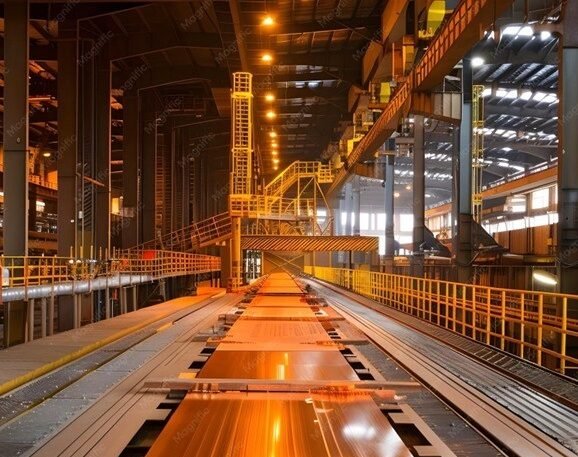
Finishing mills form the downstream stage of steel production where slabs, blooms, billets or other semi-finished products are processed into finished steel products of specified dimensions, mechanical properties, surface quality and customer requirements.
Depending on the product route, the downstream process may include reheating, rolling, controlled cooling, finishing, straightening, cutting, inspection, treatment, packing, storage and dispatch.
Reheating
Semi-finished products are reheated to the required temperature before rolling.
Typical operations include:
Slab / Bloom / Billet Receipt
↓
Charging
↓
Reheating
↓
Temperature Control
↓
Discharging to Rolling Mill
Rolling
Rolling reduces the cross-section of the heated steel and produces the required dimensions and shape.
A typical rolling sequence may include:
Roughing Mill
↓
Intermediate Rolling
↓
Finishing Mill
↓
Dimensional Control
↓
Controlled Cooling
The exact configuration varies according to the product being manufactured.
Long Product Finishing
For bars, rods and sections, downstream operations may include:
- Cooling beds
- Straightening
- Sizing
- Cutting
- Bundling
- Inspection
- Marking
- Packing
Typical sequence:
Rolled Product
↓
Cooling
↓
Straightening / Sizing
↓
Cutting
↓
Inspection
↓
Bundling & Packing
Plate Finishing
For plate products, operations may include:
Rolled Plate
↓
Controlled Cooling
↓
Levelling / Straightening
↓
Cutting
↓
Surface Inspection / Conditioning
↓
Testing
↓
Marking & Storage
Coil Processing and Finishing
For flat products, depending on the plant configuration, the downstream route may include:
Hot Rolled Coil
↓
Pickling – where applicable
↓
Cold Rolling – where applicable
↓
Annealing – where applicable
↓
Coating / Finishing – where applicable
↓
Skin Pass / Finishing
↓
Inspection
↓
Recoiling / Cutting
↓
Packing
Conclusion
Finishing completes the steel manufacturing value chain by converting semi-finished steel into customer-ready products and ensuring their inspection, identification, storage and delivery.
The downstream chain therefore extends from reheating and rolling through finishing, quality inspection, storage, handling and final dispatch
