
Steel Making
A Steel Melting Shop (SMS) is the heart of an integrated steel plant, where hot metal from the blast furnace or scrap is refined into liquid steel and cast into semi‑finished products like slabs, blooms, and billets. This is where iron becomes steel, and product differentiation begins.
Role of the Steel Melting Shop
Primary function: Converts hot metal (pig iron) or scrap into steel of desired composition.
Input materials: Hot metal from blast furnaces, scrap, fluxes, and alloys.
Output products: Slabs, blooms, billets, beam blanks, rounds, thin slabs, and coils — supplied to rolling mills.
Key Units in SMS
Hot Metal Pretreatment: Removes impurities like silicon, phosphorus, and sulfur before steelmaking.
Primary Steelmaking:
LD/BOF Converter: Oxygen is blown into hot metal + scrap to reduce carbon and impurities.
Electric Arc Furnace (EAF) or Induction Furnace (IF): Melts scrap or DRI for steel production.
Secondary Metallurgy: Ladle refining furnaces (LRF), vacuum degassing (VD/RH), argon oxygen decarburization (AOD) for precise chemistry control.
Continuous Casting: Converts liquid steel into semi‑finished shapes with dimensional accuracy and internal soundness.
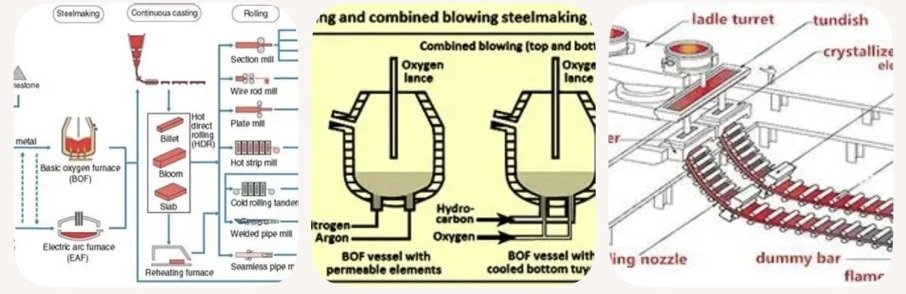
SMS FLOW AT A GLANCE
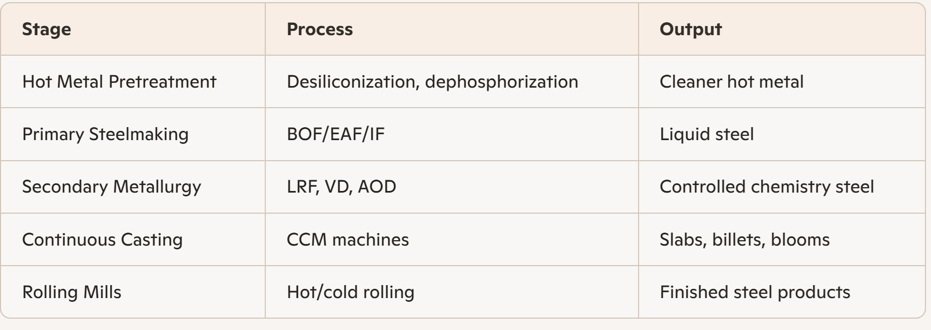
Modern Trends
Digital automation for melt control and casting precision.
Energy efficiency benchmarks: ~500–600 kWh/tonne for optimised induction melting.
Environmental compliance: Fume extraction, water treatment, and emission control systems.
Importance in Integrated Steel Plant
Customisation: Different grades of steel are produced by adjusting chemistry.
Efficiency: Determines energy consumption, yield, and downstream quality.
Risk
SMS involves hazards like extreme heat, dust, noise, fire, and gas leaks — requiring strict safety protocols.
Steel Handling and Auxiliary Systems
The steel-making area is supported by:
Ladle handling
Alloy handling
Flux handling
Cooling water systems
Dust and fume extraction
Gas systems
Slag handling