Iron Making
Hot metal (molten pig iron) making in an integrated steel plant is the core step where iron ore, coke, and fluxes are transformed inside the blast furnace into liquid iron containing ~4–5% carbon and impurities. This hot metal is then refined in the Basic Oxygen Furnace (BOF) to produce steel.
Overview of Hot Metal Making
Hot metal making is the ironmaking stage of an integrated steel plant. It converts raw materials into molten pig iron, which serves as the primary input for steelmaking.
Raw Materials: Iron ore (sinter/pellets), coke (from coking coal), and fluxes (limestone, dolomite).
Core Unit: Blast Furnace (BF) operating at ~2,000°C.
Output: Molten pig iron (hot metal) with ~4–5% carbon, silicon, manganese, sulphur, and phosphorus.
BLAST FURNACE
Blast Furnace — the centrepiece of hot metal production in an integrated steel plant — is a tall, shaft-type reactor where iron ore, coke, and fluxes are continuously charged from the top, and molten pig iron (hot metal) and slag are tapped from the bottom.
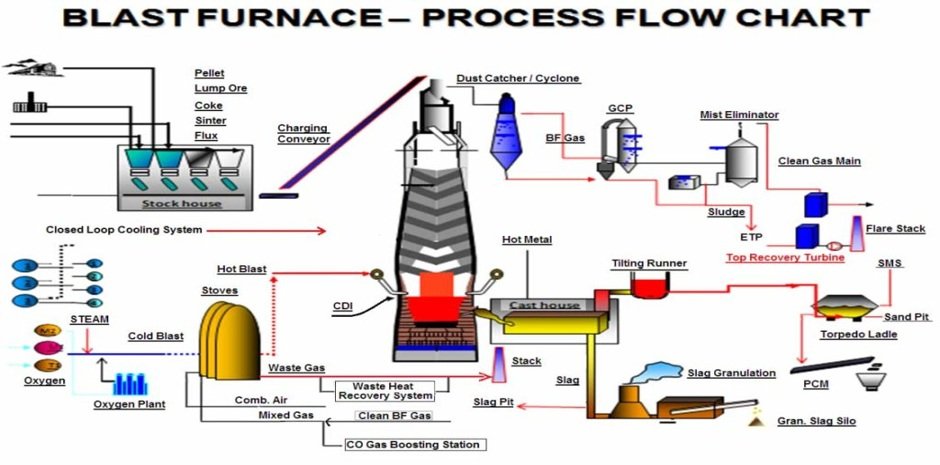
The blast furnace converts iron-bearing raw materials into liquid iron by reduction and smelting. It ensures a continuous supply of hot metal for downstream steelmaking.
Iron ore burden: Sinter, pellets, and lump ore.
Coke: Fuel + reducing agent + burden support.
Fluxes: Limestone/dolomite to form slag.
Hot blast: Preheated air blown through tuyeres.
Process Flow
Charging – Raw materials are charged from the top.
Combustion – Coke burns with hot blast, generating CO.
Reduction – CO reduces iron oxides to metallic iron.
Melting – Iron absorbs carbon, forming hot metal.
Slag formation – Fluxes combine with gangue, forming slag.
Tapping – Hot metal and slag are periodically tapped.
Zones Inside the Furnace
S No. | Zone | Temperature | Function |
1 | Stack | 200–800°C | Preheating, drying, partial reduction |
2 | Bosh | 1000–1600°C | Intense reduction, melting begins |
3 | Hearth | 1600–2000°C | Collection of hot metal & slag |
Output
Hot Metal (~4–5% C) → sent to Basic Oxygen Furnace (BOF).
Slag → used in cement and road construction.
Top Gas (CO + CO₂ + N₂) → recycled for heating stoves and power generation.
Sinter Plant
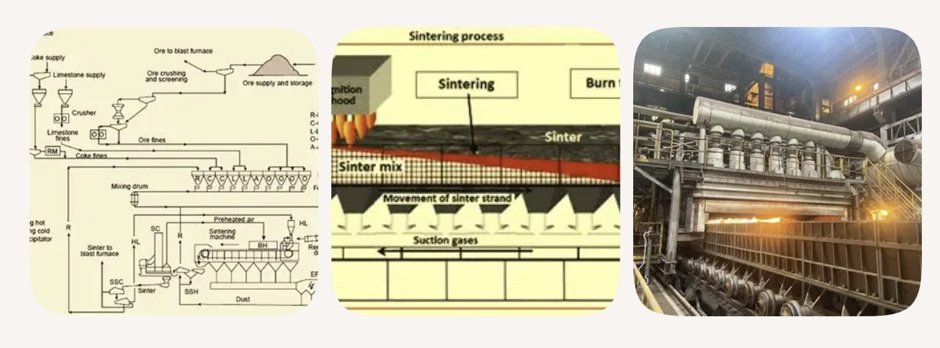
Sinter Plant — the heart of iron ore preparation in an integrated steel plant — converts fine iron ore, fluxes, and coke breeze into a porous, hard agglomerate called sinter, which serves as a strong and reactive feed for the blast furnace.
Coke Oven (CO)
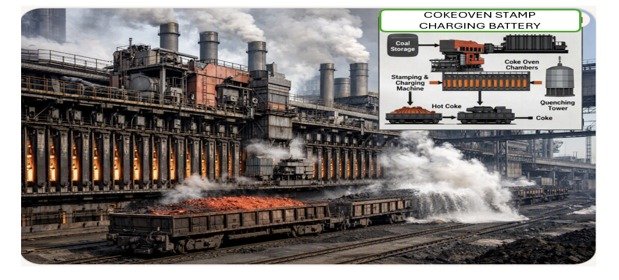
Stamp Charging Coke Oven Batteries are advanced coke-making systems that compact coal into dense “stamp cakes” before charging, improving coke strength, reducing emissions, and enabling use of lower-quality coals.
These new generation batteries have advantages over conventional batteries-
Improved Coke Strength: Stamping reduces porosity creating larger carbon domains and stronger coke.
Flexibility in Coal Use: Allows blending of premium and low-quality coals, lowering raw material costs.
Higher Productivity: Dense coal cakes increase oven throughput and efficiency.