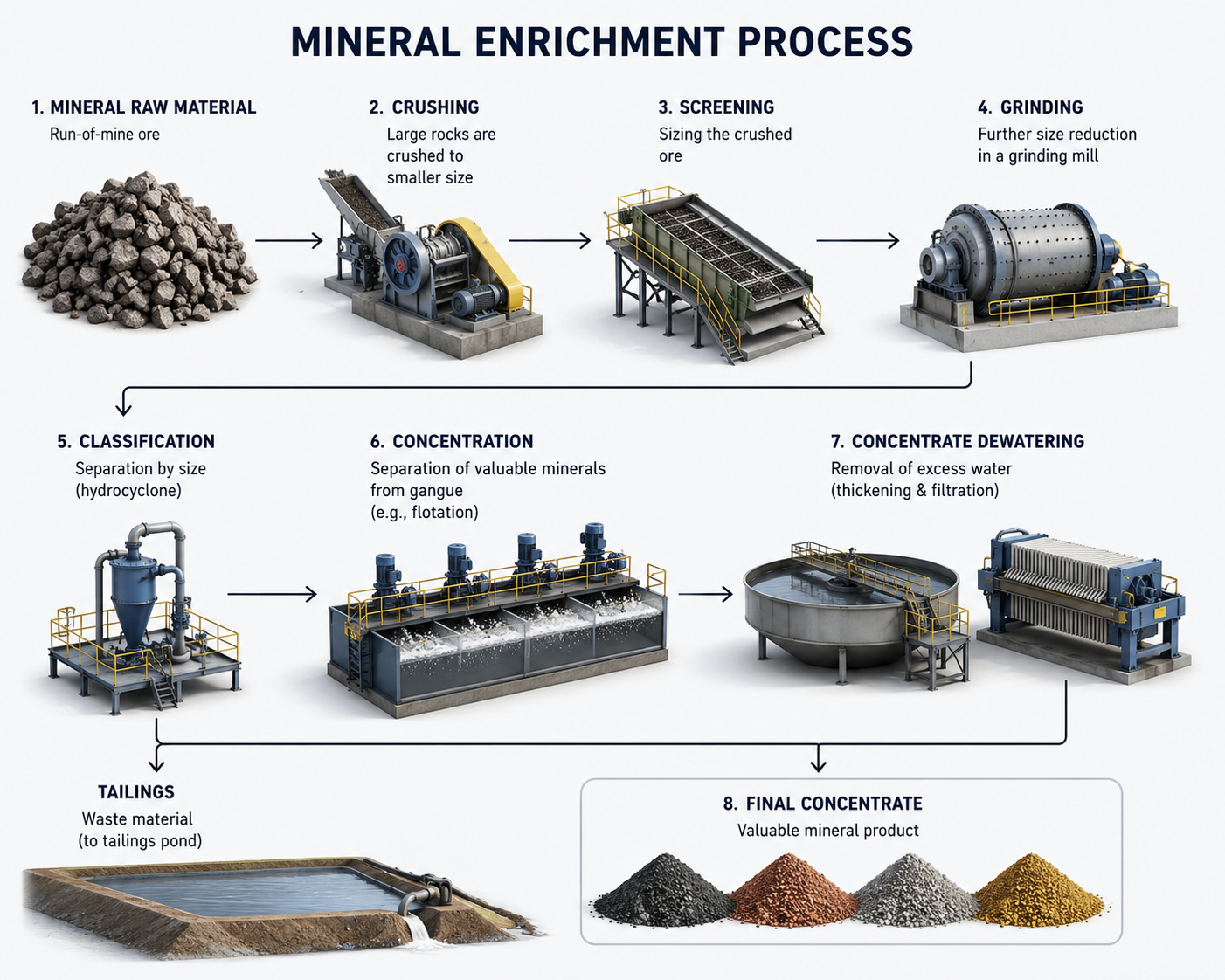
Mineral Enrichment

Mineral enrichment in the steel industry focuses on upgrading raw iron ore and coal to improve furnace efficiency, reduce impurities, and lower fuel consumption. Iron ore beneficiation enhances Fe content while coal washing reduces ash and sulphur, both critical for consistent steelmaking performance.
Iron ore beneficiation (also called mineral enrichment) is essential because raw ore often contains gangue like silica, alumina, and clay. The goal is to produce a high-grade feedstock for sintering, pelletizing, and blast furnace operations and the process involves following activities and the likely benefits expected-
  • Crushing & Screening: Reduces ore size and separates fractions.
  • Grinding: Liberates iron minerals from gangue.
  • Washing & Scrubbing: Removes clay and fines, improving Fe grade.
  • Magnetic Separation: Recovers magnetite and weakly magnetic minerals.
  • Gravity Separation: Jigs and spirals separate based on density.
  • Flotation: Removes silica/alumina when physical methods are insufficient.
  • Pelletizing/Sintering: Converts fine concentrate into usable furnace feed.
 Critical Quality Parameters:
  • Fe content: Higher Fe improves yield.
  • SiO₂ & Al₂O₃: Excess increases slag volume and flux demand.
  • Moisture & size consistency: Critical for pellet/sinter quality.

Coal BENEFICIATION

Coal preparation ensures coke quality for blast furnaces. Raw coal often contains high ash, sulphur, and moisture, which reduce calorific value and increase slag formation.
  • Coal Washing: Removes ash-forming minerals and improves calorific value.
  • Dense Media Separation: Separates coal from impurities based on density.
  • Flotation: Beneficiates fine coal particles.
  • Desulfurization: Reduces sulphur to prevent SO₂ emissions.
  • Drying: Lowers moisture for better combustion.
  Critical Quality Parameters:
  • Ash content: Lower ash improves coke strength.
  • Sulphur content: Reduced sulphur minimizes emissions.
  • Moisture: Impacts furnace efficiency.
  • Calorific value: Determines energy yield.

minderal enrich

Iron Ore Beneficiation and Pelletisation

1. Iron Ore Beneficiation:
Beneficiation is the process of improving the quality of iron ore by removing impurities such as silica, alumina, and other gangue materials. The goal is to increase the iron (Fe) content and make the ore suitable for further processing.

Main steps include:
Crushing and Grinding: Reduces ore size for easier separation.

Screening: Separates particles based on size.
Concentration Methods:
Magnetic separation (for magnetite ores)
Gravity separation
Froth flotation (for fine particles)
Dewatering: Removes moisture using thickeners and filters.
Outcome: High-grade iron concentrate with improved Fe content.
2. Pelletisation (Pelletization):
Pelletisation is the process of converting iron ore fines into small, spherical pellets (8–18 mm in diameter) suitable for use in blast furnaces and direct reduction processes.

Main steps include:
Mixing: Iron ore concentrate is mixed with binders (like bentonite) and sometimes fluxes (limestone).
Balling: Formation of green pellets using pelletizing discs or drums.
Induration (Hardening): Pellets are heated at high temperatures (≈1200–1300°C) to gain strength.
Cooling and Screening: Finished pellets are cooled and sized.
Advantages of Pelletisation:
Uniform size and shape improve furnace efficiency.

Better permeability in blast furnaces, reduced dust generation and material loss.
Enables utilization of fine ore particles.